

Very Important People
an essay by Mike Nagel
Mike Nagel’s new essay brings Little Blanksgiving to a close. Thank you to Blank from Dirt.fyi for co-publishing with us this week.
25% OFF EVERYTHING IN THE SHOP
WITH CODE BLANKSGIVING
littleengines.shop
VERY IMPORTANT PEOPLE
by Mike Nagel
Not long ago, I was sitting on the tarmac at Sea-Tac waiting for the plane to take off when a thin, grey smoke started billowing out of the air vents. Later I’d learn that it was harmless condensation, common for planes sitting on hot runways. At the time, though, it seemed like the end.
I looked around the plane to see how my fellow passengers were handling their fates. I’m proud to report that they were handling it well. The nerve of the interstate American traveler remains steadfast. Nobody seemed to mind that our plane was on fire. They were too busy playing on their iPads. iPads have come a really long way in the past few years. I’ve heard you can play Call of Duty on them now.
I was sitting back in economy class with the rest of the nobodies. Back where your comfort is not a major priority for the flight crew or airline. Back where you only get one complimentary drink and the wi-fi costs $10. Back where the plane can be on fire and you know better than to complain. They don’t know your name back here. They know your seat number.
“22b needs something again,” I would hear one of the flight attendants whisper between drink services, rolling her eyes at the sheer nerve of someone asking for what turned out to be a cup of water.
This kind of abuse takes some getting used to. Most of us have been building up a tolerance to it our entire lives, but I’d made the mistake of adjusting to a certain level of VIP treatment over the weekend. Now I was finding the detached attitudes of our flight crew a little off putting.

A few weeks earlier, my buddy Adam had texted to see if I wanted to tag along on a trip to Seattle. He’s a booking agent for some big-deal bands, and one of his artists was headlining a festival on the grounds beneath the Space Needle. We’d have backstage passes, VIP access, the whole deal.
“The whole deal?” I’d said.
“The whole deal.”
Normally I would have declined since I hate tagging along to things, especially concerts, and especially concerts in other states. But I’d made an exception in this case based on the possibility that I might meet somebody famous.
Like most unfamous people, I feel compelled to meet as many famous people as I can. I don’t want to meet them. I have to meet them. It’s what us unfamous people do. One day when I was working in Downtown Dallas, we heard James Franco was shooting a movie in the West End.
“I’m gonna go find him,” my coworker said.
“Then what?” I said.
“What do you mean then what?” she said.
Yeah, what did I mean then what? The finding was the point. The seeing was the point. Anything else would just be greedy. For most of us, seeing a celebrity involves all kinds of staking out and tracking down and other complicated logistics, but some people run into them all the time without even trying. My dad’s like that. The list of celebrities he’s run into is long and full of b-list character actors. He’s met the guy from the Maytag commercials, the girl from The Wonder Years, some lady on M*A*S*H. For years, he got Christmas cards from Howard Keel, a regular on the 1970s soap opera Dallas. One time he ran into John Goodman outside a 7-Eleven.
“I just saw you in King Ralph!” my dad said.
“Hope they gave you your money back,” John said.
Unfortunately, this ability to run into famous people does not seem to be hereditary. I’ve seen almost zero famous people in my life. My wife, J, has seen none. A kind of celebrity blindness, maybe. It’s practically clinical at this point. One time she shook hands with some guy.
“That was Martin Sheen,” they told her later.
“Was he nice?!” I asked when she got home.
All I want to know about celebrities is if they’re nice. Sometimes I want to know if they’re tall.
“Was he tall?!” I said.
If you are lucky enough to run into a celebrity, there’s no telling how you’ll react. Some people scream. Some people pass out. I heard about a woman at a David Cassidy concert who dropped dead.
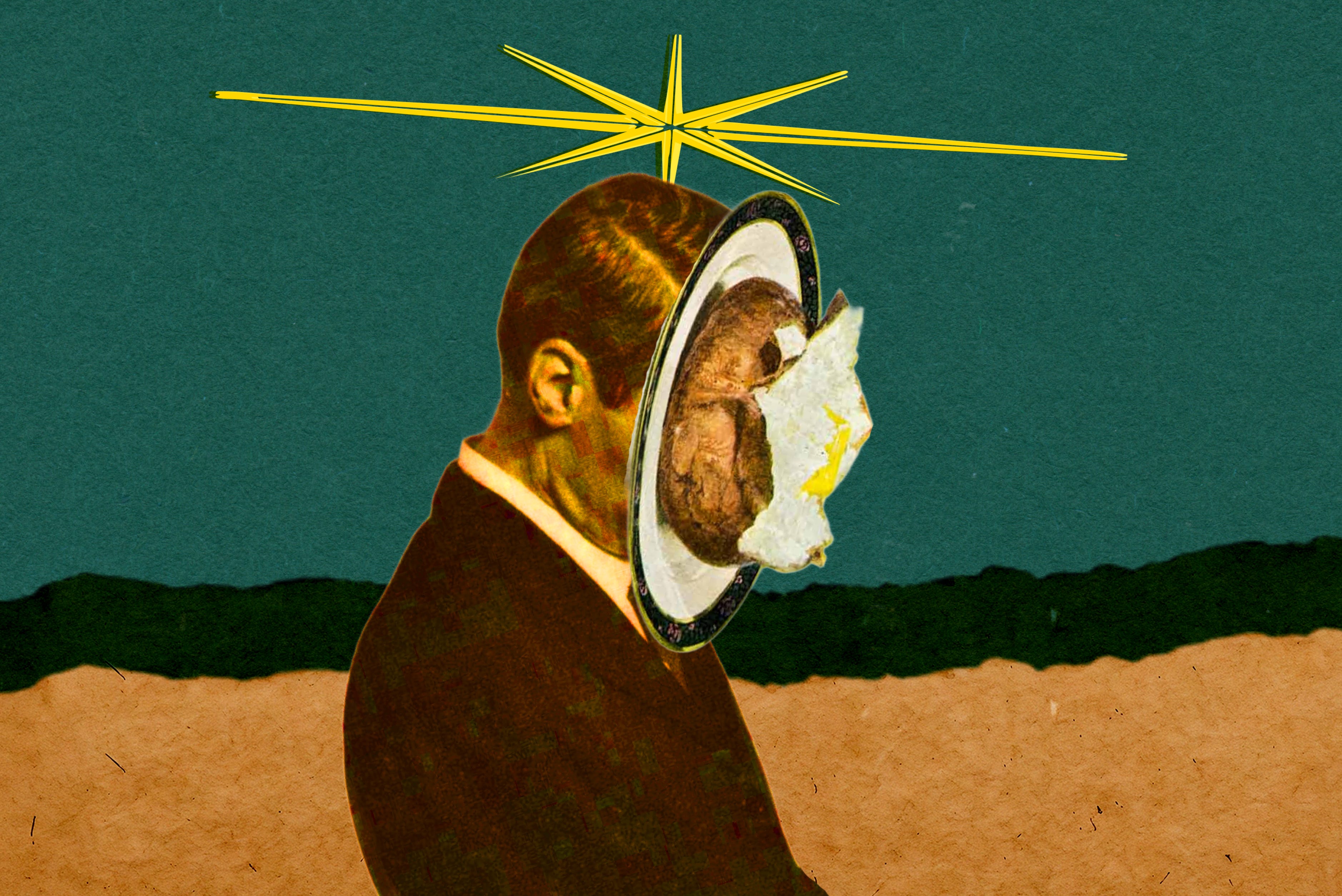
My first night in Seattle, I was eating dinner backstage with Adam when a famous rockstar sat down across from us. He’d gotten big a few years ago when one of his songs was in a Mazda commercial. I’d never been this close to a rockstar before, and I didn’t know how I was going to react. So I was surprised to see that I was reacting by fantasizing about throwing my baked potato at his head. This, I’ll admit, was not what I was expecting.
I could throw this baked potato at this guy’s head right now, I sat there thinking. It would hit him right in the face.
I seemed to be interested in the pure physics of it. That I—a non-famous person—could throw a baked potato at this famous person’s head. And that it—a baked potato—would hit him in the face. This was all purely theoretical of course. The type of thing that makes sense on paper but doesn’t quite translate into the real world, like quantum mechanics or string theory. I looked down at my baked potato, then back at the rockstar’s head.
“Hmmmmmm,” I thought.
Looking back, my reaction might not have been entirely off the map. Later I’d read about a growing trend among concert goers to throw unopened beer cans at lead singers’ heads. It seems we’ve reached the point in our relationship with celebrities where we just want to throw stuff at them. I don’t think we’re mad at them or anything. I think we just want to see what happens. See if, at the right angle and velocity, we can launch an object out of our world and into theirs. Like sending a satellite through a blackhole or petting a squirrel. It just seems worth a try.
“He seemed nice,” I said to Adam after the show, as we walked back to our hotel.
“Yeah,” he said. “He is nice.”
“And tall,” I said.
“Very tall,” Adam said.

I met Adam online a few years ago. He has a scraggly grey beard and wears the type of pastel-colored sweatshirts that make him seem approachable. While we bummed around Seattle, he was asked at least four times to take pictures of strangers. Everywhere we went, people were handing him their thousand-dollar iPhones and entrusting him with their family’s irreplaceable memories.
“It happens all the time,” he told me.
When he’s not booking world tours, Adam runs a literary magazine. A few years back, I’d sent him an essay about some dental work I’d had done, and he’d agreed to publish it provided I make a few edits.
“Try making it better,” was one of his edits.
“What if this part wasn’t lame?” was another.
Like most people who hurt my feelings, Adam and I became good friends. Mostly we text, but sometimes we hang out. Adam’s gift is not just that he can spot famous people, but that he can spot them before they’re famous. You can make a career out of that kind of thing. Most of the huge bands he works with now were nobodies when he first met them.
“That doorway is where I met Jason Molina,” he said outside a rundown club in Seattle where a naked homeless woman was now bathing herself with Gatorade.
“That’s where the guy from Death Cab records albums,” he said as we drove past what looked like an abandoned building.
“It doesn’t look like anything,” I said.
“Important places never do,” he said.

It was 73 degrees in Seattle that weekend. There were wildfires nearby, but the wind was blowing the smoke out to sea. The skies were clear, but the sunsets were bright pink, laced with ash.
Adam and I mostly hung around the festival, but one afternoon we walked to the beach. Adam remembered it being close by, but we ended up walking for a few miles before we found it. I didn’t mind. It was nice out. The air smelled like dead fish and gasoline. Two bad smells that combine to form an even worse smell that reminds me of growing up in California. My family left before I’d turned eight, but sometimes I wonder what would have happened if I’d stayed. Some of my friends there became rhythm guitarists in local rock bands.
“Go ahead, name a note,” one of them always said when I’d come back to visit. “I do them all.”
When we finally got to the beach, our shoes were filled with parking lot pebbles and our heels were covered in blisters. It was worth it though. The beach really was nice. Bigger than Adam remembered, and better than I’d expected. Full of people and kids and dogs running around off their leashes. The water was too cold to swim in, but people were flying kites and making out on picnic blankets.
This is nice, I thought.
And then, because I’m trying to be a person who spreads joy and light in the world, I said, “This is nice.”
We sat there on a bench covered in dried bird shit. It looked like someone had opened fire with a paintball gun. After a while, I noticed something out in the water. At first, I thought it was a buoy. Then I realized it was a person. They were waving their arms like maybe they needed help.
“Is that a person out there?” I said to Adam.
He squinted.
“I think it’s a buoy,” he said. “No wait. Maybe that’s a person.”
We were the furthest people away from them with a hundred beachgoers in between. Surely if this person was drowning, somebody would notice. Surely somebody would do something about it. Or maybe I’m just the type of guy who will watch another person drown as long as everybody else seems okay with it.
“Are they drowning?” I said.
“I don’t know,” Adam said. “I don’t think so. I think it’s a buoy.”
Just then Adam got a phone call. I saw his phone light up with the name of a famous musician. Adam put up his finger, whispered an apology, and wandered off. And then it was just me sitting there alone while the sky turned into cotton candy, and I watched this thing out in the water bob up and down—maybe a person, maybe a buoy—waiting for it to slip silently below the surface.

After I’d gotten over my urge to throw baked vegetables at the talent, I started getting the hang of all this celebrity stuff. The first trick was to ignore them. The second trick was to act like you belonged.
Backstage, I focused most of my attention at the craft services table. They had free Cheez-Its, Snyder’s of Hanover Pretzels, Welch’s Fruit Snacks. It looked like someone had robbed a vending machine. Not exactly a luxury spread, but on the other side of this chain-link fence, regular concert goers were gladly paying $20 for this crap. I thought about how easily we accept whatever is happening to us. Good or bad, we start to think we deserve it.
I was standing at the craft services table when I saw one of the big acts take the stage. The daughter of a huge movie star. She’d gotten big a few years ago for a song about whipping her hair back and forth. Before she started playing, she took a second to explain how love is in the air and in the trees and in the water.
“And we’re all, like, made out of water, you know!” she said. “And water is, like, you know, life!“
It was one of the stupider things I’d heard recently, but it sounded familiar. Then I remembered that I’d heard it before. A homeless guy had been saying this exact same thing down by the beach, although I had to admit the message benefited from the wireless microphone, the giant festival stage, and the thousands of screaming fans.
“There are a lot of gods and goddesses here today,” the young celebrity announced from the stage. “We’ve got to honor and worship each other, you know? Otherwise, life is just, like, kind of hell.”
She paused for a second and ten thousand fans waited silently.
“Or maybe I’m just weird!” she yelled, and the crowd went nuts.

The next morning, Adam and I split an Uber to the airport. We drove past The Space Needle, the marina, the Amazon campus shaped like a giant pair of testicles. Bezos Balls, the locals call it. At the airport, we got separated at security. Adam to TSA Pre-Check, me to general boarding.
“That you?” he said about the mile-long security line.
“Whichever line is the longest,” I said. “That’s the line I belong in.”
A few minutes later, he texted me that he’d run into a celebrity in one of the airport shops, a guy who’d been nominated for an MTV Music Video Award. By then I didn’t mind. I’d been launched like a baked potato into the world of famous people and rockstars, but it wasn’t a place I could stay. You can convince yourself you deserve anything, but you’ll know it when you’re back where you belong. In the security line, I met a woman who was rushing home for the birth of her granddaughter.
“If this line don’t hurry up, I’m gonna punch me a security guard in the face,” she said.
That’s the thing about being a nobody. You’re in good company, at least.
I ate at Pei Wei by my gate and listened to a musician playing quietly in the corner of the food court. Some local act hired to entertain weary world travelers.
She had a MacBook Pro set on a card table and was singing through a battery-powered amplifier. I wished Adam was here so he could tell me if she was going to become famous one day. I hoped so. She had a nice voice, I thought. Fragile and sincere.
And later, when my plane started filling up with smoke, I wondered if I was about to become famous too. An economy class passenger on the doomed domestic flight out of Sea-Tac. The one that never even made it off the tarmac. The one where investigators recovered the black box from the charred wreckage and heard nothing in the plane’s final moments except the calm ticking of passengers tapping on their iPads, sipping their complimentary waters, trying to figure out how to connect to the wi-fi.
MIKE NAGEL is an essayist and the author of CULDESAC and DUPLEX (now an audiobook starring Tim Heidecker).
25% OFF EVERYTHING IN THE SHOP W/ CODE: BLANKSGIVING

Baked potatoes have good heft and weight for throwing.
One of the most entertaining pieces I have read in a while !
Whilst I may not know anyone famous I do happen to have the same name as a very well known British/US actor. Hence the pseudonym. When I do use my real name I often hear the disappointment when I explain thst I am ‘not that one’. Somehow I am at fault. The plus side is that the only person who has thrown a baked potato at me is my twin brother …